
We help assign the right commodity code (HS code) to your goods before starting import or export customs clearance. The commodity code is assigned based on the goods’ nature, material, composition, principal use and other objective characteristics. Classification is based on the cargo’s actual properties, not just its commercial name.
Goods classification is based on the international HS system and, in the European Union, on the Combined Nomenclature (CN) and the TARIC system.
During commodity code classification we explain what information is needed to classify the cargo. A detailed and accurate cargo description is required. To classify the cargo, it is important to know its composition and material, its function and intended use, its technical specifications, and its manufacturing method or processing level. The more accurate the information provided, the more accurate the resulting classification.
The commodity code is used to set the applicable customs duty rates, possible restrictions and requirements, preferences, quotas and other trade measures. Commodity codes are also used for statistical purposes. ETS Logistics is a customs agency licensed by the Estonian Tax and Customs Board (operating licence no. TA/0240/EE1000EE).
Our HS code and commodity code classification is based on a practical, explanatory approach. Our customs declarants support customers in preparing the information needed to classify the goods. We explain what information is required to assign a commodity code and how the cargo is classified under the applicable nomenclature.
Several customs declarants work in our customs department. This lets us respond quickly when, before import or export clearance, the right HS code needs to be assigned to the goods.
We draw up hundreds of customs declarations every year. As a result, we deal with goods classification day in, day out and know the requirements and practices of the Estonian Tax and Customs Board (EMTA) well. We work to best practice to ensure that commodity code classification is accurate and meets the applicable regulations.
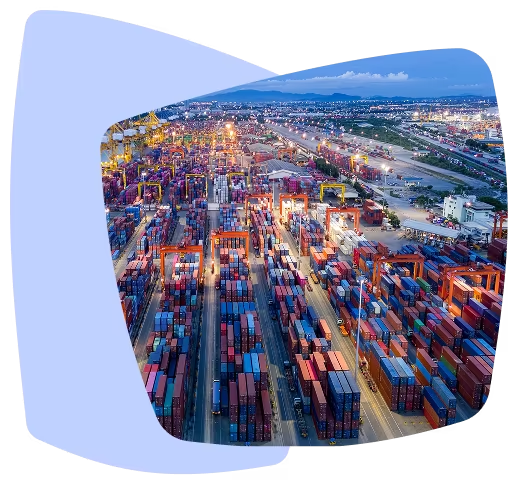
We are a customs agency licensed by the Estonian Tax and Customs Board (EMTA). Commodity code classification is part of the customs process that we encounter with every import, export and transit clearance. Because the main focus of our logistics department is international shipments that start or end outside the European Union, in practice the need to assign the right HS code often arises before customs clearance even begins.
Goods classification is an important part of the customs process. The commodity code is used to set the applicable customs duty rates, possible restrictions and requirements and other trade measures. It is therefore essential that the commodity code is assigned correctly, on the basis of sufficient technical information.
To date we have operated as a customs agency for over 10 years. Several customs declarants work in our customs department and we have drawn up thousands of customs declarations. We deal with goods classification on a daily basis and help customers assign the right HS code to their goods before submitting the customs declaration. The service can be used by businesses and private customers alike, whether or not the transport was booked with us or with another provider.
Commodity code classification is an important part of the import and export customs process. The commodity code (HS code) sets the customs duty rates applicable to the goods and is used to check whether restrictions, quotas, licensing obligations or other requirements apply. It is therefore essential that classification is done correctly before the customs declaration is submitted.
The table below gives an overview of the main HS code and commodity code classification activities that our customs declarants support customers with every day.
| Service | Content | When it is used | Example |
|---|---|---|---|
| HS code assignment | Assigning a suitable HS code to the goods based on their properties, composition, material and intended use | Before submitting an import or export customs declaration | A company imports/exports a new product and needs the right HS code assigned |
| Analysis of the information needed for goods classification | Analysis of the cargo's description, material, technical specifications and intended use | When the goods classification is unclear or the product has more than one possible classification | The material or function of the goods needs to be clarified |
| Verification of the commodity code in use | We check whether the HS code used by the company matches the goods' actual properties | When a company wants to check that its commodity code is correct | A company has used the same HS code for several years |
| Customs tariff and measures check | Based on the HS code, we check the customs duty rates, quotas, licensing obligations and other trade measures | Before planning an import or putting together an offer | A company is starting international trade and assessing the customs duties and possible restrictions on imports |
| Advice on goods-classification questions | We explain the principles of goods classification and the logic of the HS, CN and TARIC systems | When starting international trade | A company is making its first import or export transaction |
| Advice on commodity code classification | Advice on commodity code classification questions | When a company adds a new product to an import or export transaction | A company is adding a new product to its import portfolio |
Note: The information in this table is general in nature and is based on the applicable regulations and standard customs practices. Goods classification can depend on the specific item's properties, composition and intended use. Regulations and practices may change over time.
Our commodity code classification service is intended for companies, organisations and public-sector institutions involved in international trade that need to submit an import or export customs declaration. The commodity code (HS code) must be entered on the customs declaration and is used to set the applicable customs duties, possible restrictions and other requirements.
The service is also used by companies that import or export new products and need help classifying the cargo before customs clearance begins. Commodity code classification also matters at the transaction-planning stage, since the HS code is the basis on which the applicable customs duties and possible restrictions are identified. This helps the company assess whether the import or export is profitable before the transaction is made.
The commodity code (HS code) is required every time a company imports goods into Estonia or the European Union from third countries, or exports goods from Estonia or the European Union to non-EU destinations. The commodity code must be entered on the customs declaration and is used to set the applicable customs duties and possible restrictions on the goods.
Below are the main origin and destination countries for which companies need commodity code classification when carrying out import or export procedures.

Practical guidance on commodity code classification and the use of HS codes in customs procedures. We share information on situations in which a company needs to assign a commodity code before import or export customs clearance. We cover the most common questions facing companies starting international trade or submitting a customs declaration for the first time. We also explain the role of the commodity code in the customs process and what information is needed to classify the goods correctly.


Questions about commodity codes usually relate to what a commodity code (HS code) is, how goods are classified and what information is needed to assign a commodity code. Practical questions also arise about who is responsible for the correct classification and how the commodity code affects customs duties and possible restrictions.
Below we answer the most common questions about commodity code classification and the use of HS codes in customs procedures. The answers are based on the applicable classification system and on our practical experience of customs-related issues.
The commodity code, or HS code (Harmonized System code), is an internationally used system for classifying goods. In the European Union, the HS system is the basis for the 8-digit CN code used for exports and the 10-digit TARIC code used for imports.
The commodity code is assigned to the goods based on their nature, material, composition, principal use and other objective characteristics. Classification is based on the cargo’s actual properties, not just its commercial name.
The commodity code is used to set the applicable customs duty rates (for example, the customs tariff), possible restrictions and requirements, preferences, quotas and other trade measures. Commodity codes are also used for statistical purposes.
Without the correct commodity code it is not possible to draw up a customs declaration correctly. The taxation and customs control of the goods are based on the HS code, which is why correct assignment matters for both taxation and legal compliance.
The declarant and the importer — who provides the declarant with the documents and information about the goods — are responsible for correct goods classification.
Although customs may check and, if necessary, change the classification, responsibility for the accuracy of the information submitted lies with the company. An incorrect commodity code can lead to a recalculation of customs duties, fines or additional inspections.
For these reasons, the commodity code must be assigned carefully and on the basis of sufficient technical information.
Commodity code classification requires a detailed and accurate cargo description. Material certificates and similar information about the goods may also be needed.
For classification, it is important to know:
The more accurate the information provided, the more accurate the resulting classification. A general or vague description of the goods is not enough for classification.
The HS system is internationally harmonised up to six digits, which means that the general classification of goods is generally the same from one country to another.
From the seventh digit onwards, however, countries may use their own additional subheadings. The European Union uses an 8-digit CN code and a 10-digit TARIC code for imports, while non-EU countries may have different national extensions.
As a result, the detailed code for the same product can vary by country, even though the six-digit HS root code is typically the same. Likewise, taxation, quotas and trade measures may vary by country, even when the basic classification is identical.
It is advisable to check the destination country’s tariff treatment before the transaction in order to avoid unexpected tax liabilities or restrictions, such as an unexpected customs tariff.
Yes, we help with commodity code classification.
We analyse the cargo’s technical data, composition and intended use and assign a suitable commodity code under the applicable nomenclature. Where necessary, we also explain the rules on which the classification is based.
Correct commodity code classification matters as early as the purchase or sale planning stage, because it determines the customs duties, possible additional duties, quotas or restrictions that apply to the goods. An incorrect or unclear classification can affect the profitability of the transaction and cause unexpected costs on import.
Yes, the commodity code directly affects the calculation of import duties and possible restrictions and special measures.
The commodity code is used to set the customs duty rate and to check whether, for example, anti-dumping duties, quotas, licensing obligations or other trade measures apply to the goods.
An incorrect commodity code can lead to additional tax liability, an amendment of the declaration or a supervisory procedure. For these reasons, correct classification matters for both taxation and legal compliance.
Practical articles on commodity code classification and the use of HS codes in customs procedures. We cover goods classification, the role of the commodity code in submitting customs declarations and situations in which a company needs to assign a commodity code for import or export. We also explain the most common questions facing companies starting international trade or submitting a customs declaration for the first time.