
We prepare transit declarations (T1 and T2) and arrange transit clearance for shipments moving from one customs office to another under customs supervision. We check the documentation required to draw up the transit declaration and verify that the submitted data meets customs requirements. We manage the entire transit process in line with the applicable regulations and the specifics of the cargo’s movement.
During transit clearance we advise the customer on customs matters. Where needed, we provide guidance on which data and documents are required to draw up a T1 or T2 declaration, and we check them before the declaration is submitted. We also help assess when a T1 declaration must be used to move non-EU (uncleared) goods within the European Union customs territory, and when a T2 declaration is used to prove the European Union status of the goods during transit.
Transit processes are based on the requirements of the Estonian Tax and Customs Board (EMTA) and the European Union customs rules. ETS Logistics is a customs agency licensed by EMTA (operating licence no. TA/0240/EE1000EE). We prepare transit declarations both for customers using our cargo-transport service and for customers whose international transport has been booked with another provider.
Our transit (T1 and T2) clearance stands out for its practical, explanatory approach. Our customs declarants support customers in preparing the documents required to draw up the transit declaration. We explain the transit process in plain language and help prevent common mistakes before the T1 or T2 declaration is submitted.
Several customs declarants work in our customs department. This lets us respond quickly and provide operational help even when there are multiple shipments or the schedule is tight.
We draw up hundreds of transits and customs declarations every year. As a result, we know the requirements of the Estonian Tax and Customs Board (EMTA) and common practices well. We work to best practice to deliver correct transit clearance and submission of transit declarations in line with the applicable regulations.
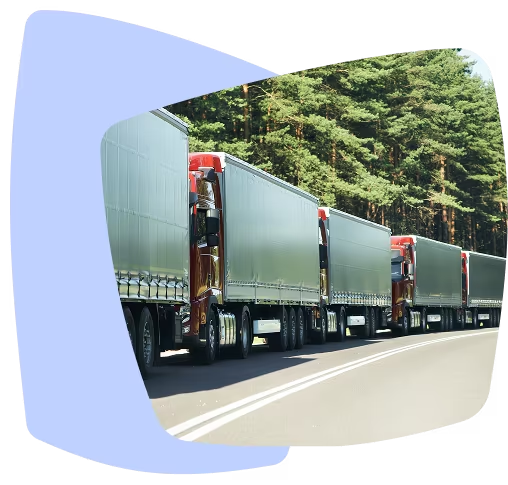
We are a customs agency licensed by EMTA. Transit clearance (T1 and T2) is one of the core areas of our customs service. Our customs department grew out of the practical need to support non-EU imports and exports as one complete process. Because the main focus of our logistics department is international shipments that start or end outside the European Union, situations arise in practice in which cargo has to move from one customs office to another under a transit procedure before final customs clearance.
This need is what got us started as a customs agency, so the customer can, on request, obtain the whole service from one company. Over the years, customs clearance has grown into a standalone and important service. The central role is played by correct documentation, clear communication and adherence to the applicable customs regulations. For us, the customs service is not just compulsory bureaucracy. It is part of a well-considered, managed supply chain.
To date we have operated as a customs agency for over 10 years. Several customs declarants work in our customs department. We have drawn up thousands of transits and customs declarations. We support customers throughout the customs process. We help them understand the requirements and ensure correct transit declaration (T1 and T2) preparation in line with the applicable rules and practices. The service can be used by businesses, public-sector institutions and private customers alike, whether or not the transport was booked with us or with another provider.
Transit clearance covers the preparation of transit declarations (T1 and T2) and the movement of goods from one customs office to another under customs supervision before the final customs procedure is completed. Transit is used in situations where goods move within the European Union customs territory before import clearance, or when European Union goods move through a non-EU country.
The table below gives an overview of the main transit services and procedures that our customs declarants support customers with every day.
| Service | Content | Where it applies | Examples |
|---|---|---|---|
| Preparing a transit declaration (T1) | Preparing a T1 transit declaration for moving non-EU goods within the European Union customs territory before import clearance | European Union | Goods arrive from China at the port of Klaipėda (Lithuania) and move to Estonia under T1, where import clearance is done |
| Preparing a transit declaration (T2) | Preparing a T2 declaration to prove the European Union status of the goods when they move through a non-EU country | European Union and non-EU countries | European Union goods move from Estonia to Ireland through the United Kingdom |
| Opening the transit procedure | Submitting the transit declaration to customs and placing the goods under transit procedure under customs supervision | European Union and common transit countries | Goods move from Rotterdam to Estonia under a T1 transit procedure |
| Closing the transit procedure | Presenting the goods at the destination customs office and correctly closing the transit procedure | European Union and common transit countries | The T1 transit is closed at an Estonian customs terminal, where the goods are placed under the next customs procedure (e.g. import) |
| Document check before the declaration | Checking the cargo and transport documents before submitting the transit declaration | International transport | The commercial invoice, packing list and transport document are checked before the T1 or T2 declaration is submitted |
| Customs advice for transit | Advice on the use of T1 and T2, documents and transit procedure requirements; verification before submitting the transit declaration | International transport | We assess whether a T1 or T2 transit procedure should be used for the shipment |
Note: The information in this table is general in nature and is based on the applicable regulations and standard customs practices. The conditions and requirements of transit procedures may depend on the specific cargo, route, goods' status and the decisions of the customs authority. Regulations and practices may change over time.
Our transit (T1 and T2) clearance is intended for companies, public-sector institutions and private individuals whose goods move through multiple countries in the international supply chain and need to be moved from one customs office to another under a transit procedure before final customs clearance.
The service is used in situations where goods arrive at a European Union port, airport or customs terminal and move on to another country where import clearance is done. A T1 or T2 transit declaration is also used when European Union goods move through a non-EU country and the goods’ status needs to be proven to customs.
Transit clearance is needed in situations where goods move from one country to another, and the movement is carried out under a transit procedure (T1 or T2) before final customs clearance. These situations arise, for example, when goods arrive at a European Union port or terminal and move on to another country where import clearance is done, or when European Union goods move through a non-EU country.
Below are the main countries through which we prepare transit declarations (T1 and T2) for shipments on behalf of our customers.

Practical guidance for preparing transit clearance (T1 and T2). We share information on transit procedures, the required documents and the customs requirements to consider when moving goods from one customs office to another under customs supervision. We cover the most common questions and situations that arise when preparing the transit declaration, including document preparation, the principles for using T1 and T2, and closing the transit procedure at the destination customs office.


Questions about transit clearance usually concern when a T1 or T2 transit procedure must be used, what documents are required to draw up the transit declaration, and how goods move under customs supervision from one customs office to another. Practical questions also arise about who is responsible for submitting the transit declaration, what data must be included, and how the transit procedure is closed at the destination customs office.
Below we answer the most common questions about transit (T1 and T2) clearance. We explain when a T1 or T2 transit document must be used, what data and documents are required to submit the declaration, and what rules apply to the movement of goods under customs supervision. The answers are based on our day-to-day practical experience of preparing transit declarations and on the rules of the Estonian Tax and Customs Board (EMTA) and the European Union.
T1 and T2 are transit documents used to move goods from one customs office to another without the goods having to undergo an import procedure in between.
T1 is used to move non-EU goods (i.e. uncleared goods) within the European Union customs territory. This allows goods to be carried, for example, from one Member State to another before import clearance and the payment of import duties.
T2 is used to prove the European Union status of goods when they move through a non-EU country or territory where the goods’ status must be proven to customs (e.g. when EU goods move to Ireland through the mainland of the United Kingdom).
Transit allows the goods to move under customs supervision to the destination customs office, where the procedure is closed.
A T1 must be drawn up when the goods have not yet been released for free circulation in the European Union and are being moved through several Member States before import clearance. For example, if goods arrive at an EU port but import is cleared in another Member State, a T1 document is used.
A T2 must be drawn up when EU goods move to another Member State through a non-EU country. For example, if goods with EU status are moved through Switzerland to another Member State, then on entry into Switzerland the goods must be covered by a T2, otherwise import clearance will be required at the Swiss border.
It is important to bear in mind that the transit document is drawn up before the goods start moving, and the goods must reach the destination customs office within the set time limit.
The party responsible for preparing the transit document is generally the person or company that submits the transit declaration and takes responsibility for the goods’ movement under customs supervision.
In practice this can be the carrier, the freight forwarder or a customs representative acting under a power of attorney. The party submitting the transit declaration is responsible for ensuring that the goods reach the destination customs office and that the procedure is correctly closed.
Transit also carries financial responsibility — if the goods do not reach their destination or the procedure is not correctly closed, customs may demand payment of customs duties from the declarant or the guarantor.
To draw up a T1 or T2, correct cargo and transport documents are needed, along with accurate data on the movement of the goods. In addition, drawing up a T1 requires a prior customs declaration (either the origin country’s export declaration, a prior T1 transit declaration, or similar).
It is important that the data submitted is accurate and matches the actual cargo, since the transit takes place under customs supervision and the destination customs office checks that the data matches.
No, a T1 document cannot be drawn up after the goods have left.
A T1 must be drawn up and accepted by customs before the goods start moving in the country of origin. Transit starts the moment customs accepts the declaration and the goods are released under the transit procedure.
If the goods start moving without a correctly drawn-up T1 document, this is treated as a breach of customs requirements and may result in the goods being detained, fines or a demand for the payment of customs duties.
For this reason it is essential to ensure the transit document is correctly drawn up before the goods leave the place of origin.
If there are errors in the transit document, this may prevent the procedure from being closed at the destination customs office.
Where there are errors, customs may demand additional explanations and, in some cases, this can lead to an inspection or delay.
For this reason it is essential that all the data is carefully checked before the declaration is submitted. Where required, we help review the data in advance to reduce risks and avoid subsequent problems.
Practical articles on transit (T1 and T2) clearance. We explain situations in which goods move from one country to another under a transit procedure before final customs clearance. We cover the documents required to draw up the transit declaration (commercial invoice, packing list, transport document) and explain the principles for using T1 and T2, the movement of goods under customs supervision and closing the transit procedure at the destination customs office.