
We prepare import customs declarations and arrange import customs clearance for shipments arriving in Estonia and in other European Union countries. We check the documentation required for customs clearance and verify that the submitted data meets customs requirements. We manage the entire customs process in line with the applicable regulations and the specifics of the cargo.
During import customs clearance we advise the customer on customs matters. We also help with the calculation and payment of import duties (customs duty and VAT) to the Estonian Tax and Customs Board. Where required, we provide guidance on what documents are needed for customs clearance and check them before the declaration is submitted.
Import customs processes are based on the requirements of the Estonian Tax and Customs Board (EMTA) and on European Union customs rules. ETS Logistics is a customs agency licensed by EMTA (operating licence no. TA/0240/EE1000EE). We provide import customs clearance both to customers using our cargo-transport service and to customers whose international transport has been booked with another provider.
Our import customs clearance stands out for its practical, explanatory approach. Our customs declarants support customers in preparing the documents required for import customs clearance. We explain the customs process in plain language and help prevent common mistakes before the import customs declaration is submitted.
Several customs declarants work in our customs department. This lets us respond quickly and provide operational help even when there are multiple shipments or the schedule is tight.
We draw up hundreds of customs declarations every year. As a result, we know the requirements of the Estonian Tax and Customs Board (EMTA) and common practices well. We work to best practice to ensure correct import customs clearance and the calculation and payment of import duties in line with the applicable regulations.
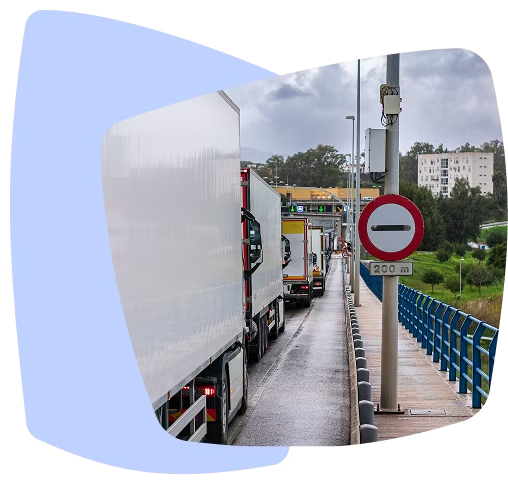
We are a customs agency licensed by EMTA. Import customs clearance is one of the core areas of our customs service. Our customs department grew out of the practical need to support non-EU imports and exports as one complete process. Because the main focus of our logistics department is international transport that starts or ends outside the European Union, we wanted to offer customers the option of obtaining import customs clearance from the same office that arranges their transport.
This need is what got us started as a customs agency, so the customer can, on request, obtain the whole service from one company. Over the years, customs clearance has grown into a standalone and important service, in which the central role is played by correct documentation, clear communication and adherence to the applicable customs regulations. For us, the customs service is not just compulsory bureaucracy. It is part of a well-considered, managed supply chain.
To date we have operated as a customs agency for over 10 years. Several customs declarants work in our customs department. We have prepared thousands of import customs declarations. We support customers throughout the customs process. We help them understand the requirements and ensure correct import customs clearance in line with the applicable rules and practices. The service can be used by businesses and private customers alike, whether or not the transport was booked with us or with another provider.
Import customs clearance can be carried out under different customs procedures. In addition to the standard import customs declaration, special procedures are also used in certain cases. These allow temporary import into the European Union, processing of goods within the European Union or applying for a tax exemption for the import of personal belongings.
The sub-services below give an overview of the most frequently used import customs procedures. These include temporary import, inward processing and customs clearance of personal belongings for people relocating, along with applying for a tax exemption. Our customs declarants help choose the right import customs procedure and prepare the necessary import customs declarations and documents.
Import customs clearance covers the preparation of import declarations for goods arriving in Estonia or in the European Union from third countries, as well as various import-related customs procedures. The table below gives an overview of the main import customs services and procedures with which our customs declarants support customers every day.
| Service | Content | When it is used | Typical use case |
|---|---|---|---|
| Import customs clearance | Preparing the import customs declaration and calculating import duties | When goods arrive from a third country in Estonia or the European Union | Shipments from outside the European Union |
| Temporary import | Preparing the temporary import customs declaration and calculating the guarantee | When goods are temporarily brought into the European Union | Exhibition equipment, rental equipment or equipment brought in for testing |
| Inward processing | Declaring the goods under the inward processing customs procedure for processing or repair without paying import duties, and calculating the guarantee | When goods are processed in the European Union and subsequently re-exported | Processing or repair before the goods are re-exported |
| Customs clearance of personal belongings for people relocating | Import customs declaration for personal belongings and applying for a tax exemption | When a private individual relocates from a third country to the European Union | Import of personal belongings on relocation |
| Verification of certificates of origin | Verification of proofs of origin (EUR.1, A.TR) at import customs clearance | When applying for a customs duty preference | Customs duty reduction or exemption |
| Calculating import duties | Calculating customs duty, VAT and other import duties | Before drawing up the customs declaration or when planning imports | Planning import costs and duties |
| Document check before the declaration | Checking the commercial invoice, packing list and transport documents before the declaration is submitted | Before import customs clearance | Avoiding errors and delays |
| Customs advice for imports | Advice on import customs procedures, documents and import duties | When planning imports | Preparing a new import process |
Note: The information in this table is general in nature and is based on the applicable regulations and standard customs practices. The conditions of import customs clearance, the level of import duties and the applicable customs procedures may depend on the specific cargo, its origin, intended use and the decisions of the customs authority. Regulations and practices may change over time.
Our import customs clearance is intended for companies, organisations and public-sector institutions that import goods from third countries into Estonia and need help preparing the import customs declaration, calculating state duties and paying them correctly.
The service is also suitable for private individuals relocating from a third country to Estonia or the European Union who need help with import customs clearance for their personal belongings and applying for a possible tax exemption.
Import customs clearance is needed every time goods arrive from third countries in Estonia or the European Union. In such cases an import customs declaration must be drawn up for the goods and the applicable state duties paid. Below are the main origin countries from which we prepare import declarations in Estonia.

Practical guidance for preparing import customs clearance and the import declaration. We share information on import customs procedures, documents and the calculation of state duties. We cover the most common questions and situations that may arise when importing goods from third countries into Estonia or the European Union. We also explain the various customs procedures and special conditions that may apply to imports.

Questions about import customs clearance usually concern when the import declaration must be drawn up, what documents are required for customs clearance and how long the process typically takes. Practical questions also arise on topics such as the calculation of import duties, customs inspections and the various import customs procedures.
Below we answer the most common questions about import customs clearance, the documents needed, import customs procedures and customs clearance of personal belongings for people relocating. The answers are based on our day-to-day practical experience of preparing import customs declarations in Estonia.
Import customs clearance is the procedure under which goods arriving from a non-EU country are declared to customs and the applicable import duties (customs duty, VAT and, where required, other duties) are paid.
An import declaration must be drawn up for all goods arriving from a non-EU country. After the declaration is correctly submitted and the import duties paid, customs releases the goods for free circulation or refers them for additional customs inspection.
As a rule, goods are referred for customs inspection when
• the customs value of the goods needs to be clarified;
• the safety of the goods needs to be checked;
• compliance with European Union requirements needs to be assessed:
• the data submitted contains inaccuracies.
During an inspection, you must be prepared to provide additional documents and explanations about the goods.
In practice, customs inspections run smoothly when the information submitted, the cargo description and the documents are correct and sufficiently detailed.
An import declaration must be drawn up when goods arrive from a non-EU country in the European Union customs territory.
The declaration can be submitted to customs after the goods have physically arrived and the arrival documents have been issued by the port, airport or customs terminal.
We recommend starting to prepare the declaration even before the goods arrive. This matters so that all the necessary documents and data from the consignor are in place in good time. In certain cases, goods classification (assigning the HS code) and checking special conditions can be more time-consuming.
Early preparation helps avoid delays and ensures faster customs clearance as soon as the goods arrive.
The documents needed to prepare the import declaration depend on the type of transaction, the goods and the country of origin.
The following documents are typically required:
• commercial invoice
• packing list
• transport document (CMR, bill of lading, airway bill or other)
• transport invoice
Depending on the goods, additional documents may also be needed, for example:
• certificate of origin (EUR.1, A.TR or other proof)
• declarations of conformity and certificates (e.g. CE)
• import licences or other special permits
We recommend forwarding the documents for the incoming goods to us at the earliest opportunity. That way we can check the requirements applicable to the specific goods and, where required, clarify or request the additional documents in good time to avoid delays in customs clearance.
The duration of import customs clearance depends primarily on the accuracy of the documents, the nature of the cargo and whether customs refers the shipment for inspection.
If all the data and documents are in order and no inspection is set, customs clearance usually takes a few hours.
If the goods are referred for inspection, the procedure may take longer. Customs typically starts the inspection within three working days of the declaration being submitted.
There are generally two types of inspection:
• “yellow corridor” – document check
• “red corridor” – physical inspection of the goods
During the inspection, customs may request additional documents or explanations, which can affect the duration of the procedure.
We recommend submitting complete and accurate documents before the goods arrive so we can prepare the declaration thoroughly. This helps speed up the whole customs clearance process and reduces the risk of possible delays.
Temporary import is the customs procedure that allows goods to be brought temporarily into the European Union on condition that they are taken back out of the EU in an unchanged form within the prescribed time limit.
When using temporary import, you generally have to:
• provide a guarantee to customs;
• set a time limit by which the goods must be re-exported or placed under another customs procedure;
• describe what the temporarily imported goods are used for.
Temporary import is used, for example, for rental equipment or for goods brought in temporarily for testing.
Where processing operations are performed on the goods (e.g. repair, processing, finishing), the inward processing customs procedure is used.
Special procedures require careful planning and documentation. We help select the right customs procedure, prepare the necessary documents and explain the whole process step by step.
Yes, we help people relocating both with the customs clearance of personal belongings on import and with the tax exemption application.
When relocating to the European Union, it is possible to apply for a customs duty and VAT exemption on personal belongings under certain conditions. To obtain the tax exemption, specific requirements must be met that depend on the reason for the move or import (e.g. permanent relocation, marriage, taking up studies).
Since every case is different, we send the exact list of required documents once we have an overview of the specific situation. We also check in advance whether the conditions for applying for the tax exemption are met.
We help throughout the whole process — from preparing the documents to submitting the declaration.
Practical articles for preparing import customs clearance and import declarations. We cover the documents needed for customs clearance, the calculation of import duties, goods classification (HS / CN code), certificates of origin and various import customs procedures. We also explain the most common questions that may arise when importing goods from third countries into Estonia or the European Union, including customs inspections, special procedures, and customs clearance and tax exemption for the personal belongings of people relocating.
