
Container shipping is a transport mode used widely around the world. It is an environmentally responsible and cost-efficient solution for moving goods. We arrange business-to-business (B2B) FCL and LCL container shipments on routes that start or end outside the European Union. Our main routes are Asia (especially China–Estonia transport), the USA, Türkiye, the United Kingdom and other non-EU destinations.
In addition to sea transport, we arrange pre- and on-carriage according to the delivery term (Incoterms). We also operate as a customs agency, which means that, within a single service, we can also take care of customs clearance and related matters. That means fewer parties involved, fewer errors and smoother cargo flow.
Our service covers the entire organisation of sea container transport — route planning, consolidation, shipping-line bookings, pricing, document checks and customs clearance. Long-standing partnerships in China, the USA and other non-EU markets enable efficient communication and flexible solutions.
We are equally suited to regular container shipments (FCL and LCL) and to project and special shipments. We track the transport throughout the process and keep the customer informed of any significant changes.
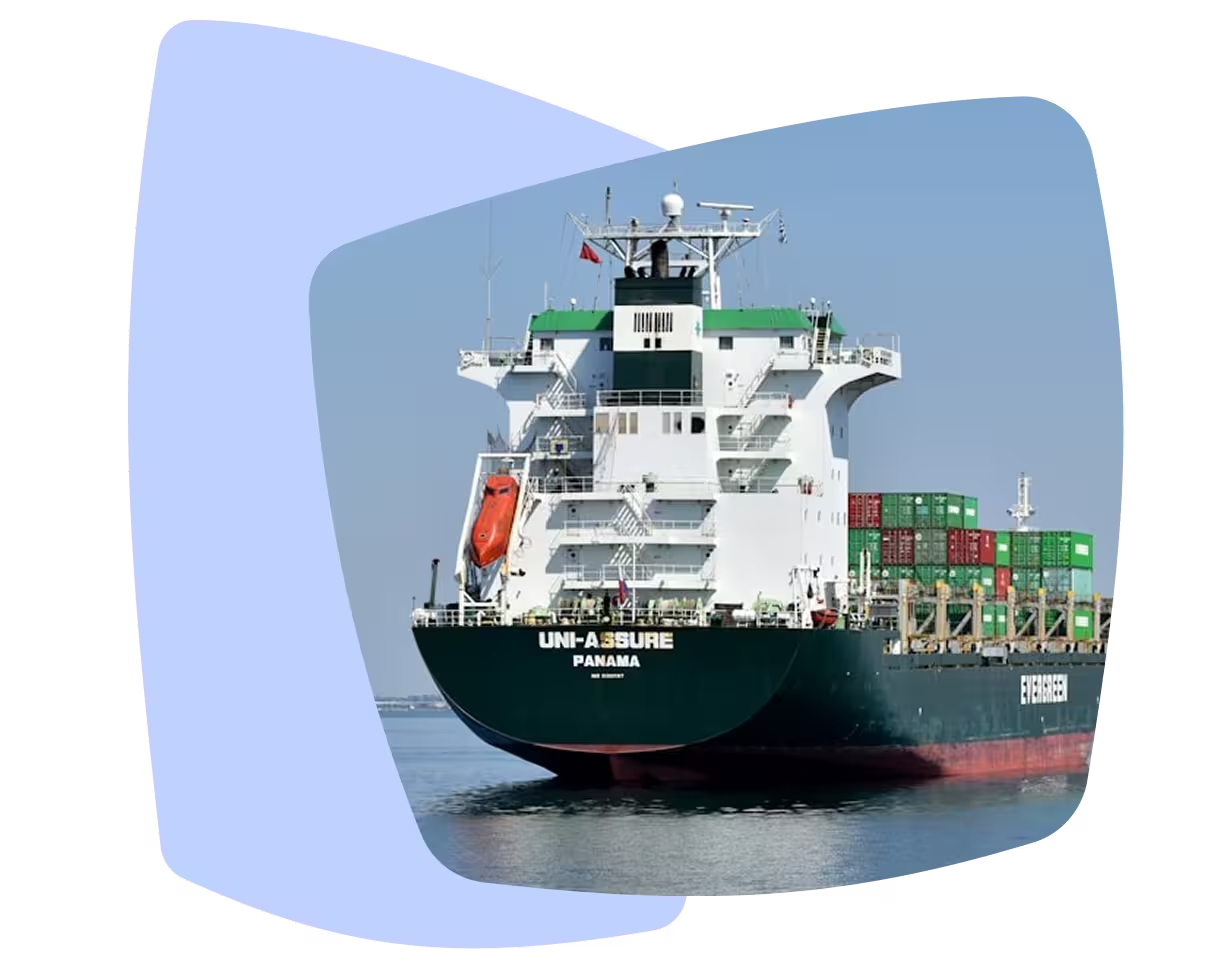
Our company started from a wish to offer Estonian exporters and importers a more flexible and reliable sea-transport service. From the very beginning we have built partnerships where logistics is not merely a cost item but strategic support — from procurement and purchasing planning to organising exports and supporting sales processes.
Over the years we have grown alongside our customers, expanding our sea-transport services from FCL and LCL container shipments to a full-service sea-transport offering. This covers container transport, customs clearance and cargo insurance. Our strength lies in non-EU destinations, especially Asia and China–Estonia container shipments, and in our practical experience managing international cargo flows.
Today we serve industrial, manufacturing and trading companies as well as public-sector institutions that need a reliable, experienced partner for their non-EU export and import container shipments. We do not simply arrange transport — we help our customers make well-considered, workable decisions across the whole sea-transport process.
Together we choose the most suitable container-transport solution based on the cargo’s dimensions, weight and delivery term (Incoterms).
We advise when it makes sense to use full-container transport (FCL) and when part-container service (LCL) is preferable, so that the container transport is technically and economically justified for the cargo type and destination market.

We arrange non-EU container shipments on specific sea-transport lanes where the origin or destination is Estonia. We plan solutions based on the nature, dimensions, weight, delivery term and destination market of the cargo — for both FCL and LCL shipments.
The table below lists the main sea-transport lanes and indicative transit times.
| Destination market | Main origin and destination ports | Origin or destination port in Estonia | Service type | Indicative transit time* |
|---|---|---|---|---|
| China | Shanghai, Ningbo, Shenzhen, Guangzhou, Qingdao | Muuga | FCL / LCL container shipments | ~45–60 days |
| USA | Los Angeles, Long Beach, New York / New Jersey, Savannah, Houston, Norfolk, Oakland, Chicago (CY) | Muuga | FCL / LCL container shipments | ~25–40 days |
| Canada | Vancouver, Montreal, Halifax | Muuga | FCL / LCL container shipments | ~30–45 days |
| Taiwan | Kaohsiung, Taipei | Muuga | FCL / LCL container shipments | ~45–60 days |
| Türkiye | Ambarlı (Istanbul), Mersin, Aliaga (Izmir) | Muuga | FCL / LCL container shipments | ~15–30 days |
* Transit times are indicative and may vary depending on direction (export or import), shipping line, transhipment, port and customs processes, and pre- and on-carriage.
Our container shipments are intended for industrial, manufacturing and trading companies as well as public-sector institutions that handle non-EU exports or imports by sea.
We handle non-EU FCL and LCL container shipments, covering both imports into Estonia (e.g. from China to Estonia) and exports from Estonia (e.g. to the USA). We carry standard cargo as well as hazardous goods classified under the IMDG Code (including batteries and energy storage systems). We support communication with overseas consignors and consignees. Operating as a customs agency, we also draw up customs declarations and handle communication with the Estonian Tax and Customs Board (EMTA) and other authorities.

Practical guidance for organising FCL and LCL container shipments. We compare FCL and LCL services, describe the customs processes and offer advice on choosing delivery terms (Incoterms).

We handle non-EU container shipments — both imports into Estonia and exports from Estonia. FCL and LCL solutions account for the majority of standard and hazardous-goods shipments, and they let you pick the right option for the cargo type, dimensions and delivery term.
Below we answer the most frequently asked questions, from choosing the right container service to documentation, customs processes and selecting the delivery term (Incoterms). If you don’t find an answer, get in touch — we are happy to answer further questions and help plan your shipment.
For FCL container transport, the shipping line or its agent allocates an empty container to the logistics company. The container is released from the container terminal at the port of loading and, once unloaded, returned to the container terminal at the destination port. It is the property of the shipping line, used to perform the specific shipment. It is the customer’s responsibility to release and return the container by the agreed deadline and in good condition to avoid additional charges.
For LCL container transport, the customer does not rent a whole container. With LCL the customer generally does not see the sea container at all, since pre- and on-carriage is done with normal trucks. The cargo is consolidated at the terminal together with other shipments, and container handling is taken care of by the carrier and consolidator.
The choice between FCL and LCL container shipping depends on the cargo’s dimensions and weight. LCL is suitable for smaller shipments that do not fill an entire sea container. FCL means that only one customer’s goods are loaded into a single sea container.
In our experience it is worth considering FCL once the cargo volume exceeds roughly half the total volume of a 20DC, 40DC or 40HC container. For example, a 20DC container holds about 33 m³, so if a shipment is roughly 20 m³ an FCL solution may be cheaper than LCL.
The advantage of FCL is that cargo inside the container is not reloaded during transit. The goods are not taken out of the container in transit — they are loaded at origin, and the container doors are not opened again until destination. With LCL container transport, the cargo is reloaded several times during transit.
The customer does not need to worry about the choice. For each shipment we assess the nature, dimensions and weight of the cargo and recommend which container option is most appropriate.
The price of container shipping depends on the route, container type (20DC, 40DC, 40HC, etc.), the dimensions and weight of the cargo, and whether the solution is FCL or LCL.
The biggest influence on FCL and LCL pricing comes from international container shipping-line rates. There are only a limited number of shipping lines serving Estonia (e.g. Maersk, MSC, Hapag-Lloyd and a few others), and they typically adjust rates one or two times per month. Rates are market-driven and dynamic, depending on demand, seasonality and the margin the shipping lines are seeking. Tariff fluctuations are comparable to the regular changes in fuel prices.
For FCL the price is generally per container size. For LCL the charge is based on cargo volume (m³) or weight, whichever is higher.
In practice it is often economically sensible for a customer to consolidate shipments into larger batches. The bigger a single container shipment, the lower the cost per kilogram or per cubic metre may be.
The single most important transport document is the bill of lading. It is drawn up by the carrier or freight forwarder. Good practice is to send the bill of lading to the consignor or consignee for review before final confirmation, so the details can be checked (cargo description, quantities, parties, ports, etc.). Once confirmed, the document is the basis on which the cargo is released at destination.
Other documents involved in arranging container transport include the commercial invoice and packing list. Depending on the cargo and destination country, a certificate of origin or an A.TR movement certificate may also be required.
For hazardous cargo (IMO / IMDG) additional documents may apply, such as the MSDS (Material Safety Data Sheet), the Certificate for Safe Transport of Chemical Goods by Sea and the UN 38.3 Test Summary — particularly for batteries and energy storage systems.
Before the shipment starts we check the documents for compliance and flag any potential gaps, so as to avoid delays and extra costs further down the line.
Yes, we help with the customs declaration for container shipments, as we also operate as a customs agency.
That means that, on request, we provide customs clearance and handle related matters. We draw up both import and export declarations, help with the calculation and payment of state duties, and support communication with the Estonian Tax and Customs Board (EMTA) and other authorities.
Timely and correct customs clearance is important in order to avoid additional costs. If the customs declaration is not filed or is filed late, the container may be left standing at the port or terminal. In practice this means unnecessary extra cost in the form of demurrage charges. Demurrage is a fee for the container’s stay at the port terminal after the free time has expired. Customs clearance must not be delayed, as the additional costs can be substantial.
By using our customs service you ensure that we do everything possible to deliver timely customs clearance and avoid unnecessary additional costs.
Yes, we also carry out FCL and LCL container shipments for hazardous goods under IMO / IMDG requirements. These include, among others, energy storage systems, equipment containing lithium-ion batteries and other goods classified as hazardous. Such shipments are subject to stricter requirements for packaging, labelling and documentation, and are only carried out after prior coordination with the shipping line.
ETS Logistics does not arrange shipments of hazardous goods belonging to DGR classes 1, 3, 6 and 7. For every hazardous-goods enquiry we first assess whether the cargo is suitable for sea transport and advise on the required documents (e.g. MSDS, Certificate for Safe Transport and UN 38.3 Test Summary), so that the shipment complies with the applicable safety and transport requirements.
Practical guidance for organising FCL and LCL container shipments. We compare full- and part-container services, describe the required documents and offer advice on choosing the delivery term (Incoterms) on non-EU routes.