
Our main focus is business-to-business (B2B) hazardous-goods transport (ADR transport) on routes where the origin or destination country is outside the European Union and the shipment includes — in addition to road transport — customs clearance and transit (T1) formalities. We arrange international ADR transport between Estonia and non-EU countries such as Norway, the United Kingdom, Turkey and Switzerland. We also operate as a customs agency, so on request you can have customs clearance and the related processes covered within the same service — making the entire transport process manageable from a single point.
Hazardous-goods transport requires more than a CMR consignment note alone — it requires compliance with ADR rules, correct labelling, regulation-compliant packaging and proper hazardous-goods documentation. Carrying dangerous goods requires a Material Safety Data Sheet (MSDS) and, where applicable, a Dangerous Goods Declaration (DGD). We carry out ADR transport with trucks that meet the requirements for hazardous-goods carriage, and we work in line with the ADR classes and hazardous-substance classification that determine handling, labelling and transport conditions.
Our service covers the entire organisation of hazardous-goods (ADR) transport — route planning, choice of vehicle and trailer, ADR-compliant handling, document checks, cargo insurance and, on request, customs clearance and advice. We operate regularly on routes towards non-EU countries, including Norway, the United Kingdom, Turkey, Switzerland and Serbia.
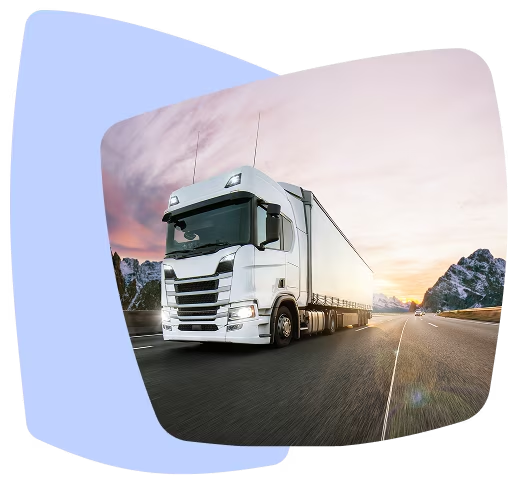
Our hazardous-goods (ADR) transport service grew out of the need to offer Estonian exporters and importers a clear and managed solution for non-EU shipments. ADR shipments require more than just transport — the proper handling of hazardous substances, correct documentation and continuous coordination of the transport process are equally important.
Over the years we have built up our capability for international ADR transport, covering different classes of hazardous substances and, where required, special and oversized shipments. The service also covers customs clearance on request, including the calculation and payment of state duties, transit procedures (T1) and cargo insurance based on the cargo’s risk level.
Today we serve manufacturing, industrial and trading companies as well as public-sector institutions that need a reliable partner for arranging non-EU ADR shipments. Our role is not limited to booking shipments — we help the customer make well-considered decisions across the entire transport chain, keeping the process under control from start to finish.
We mainly carry out hazardous-goods transport on non-EU routes, both for export and import. We carry hazardous substances of various ADR classes in line with the applicable transport requirements, and — on request — also standard cargo and oversized shipments. We perform hazardous-goods transport with semi-trailers, mega, jumbo, full and flatbed trailers and tail-lift trucks, depending on the nature of the cargo and the ADR requirements.
We also operate as a customs agency, so on request our service covers customs declarations, the calculation and payment of state duties, and transit (T1) formalities. The table below shows the most frequently used routes along with estimated transit times. The exact price and schedule depend on the specific route, departure schedule and the specifics of the shipment.
| Destination market | Main regions | Origin or destination | Transport type | Estimated transit time* |
|---|---|---|---|---|
| Norway | Oslo, Bergen, Trondheim, Stavanger, Kristiansand | All across Estonia | FTL / LTL / special shipments / time-critical | ~2–7 days |
| Switzerland | Zürich, Basel, Bern, Geneva | All across Estonia | FTL / LTL / special shipments / time-critical | ~3–9 days |
| United Kingdom | London, Manchester, Birmingham, Liverpool, Leeds | All across Estonia | FTL / LTL / special shipments / time-critical | ~4–10 days |
| Serbia | Belgrade, Novi Sad, Niš | All across Estonia | FTL / LTL / special shipments / time-critical | ~4–10 days |
| Turkey | Istanbul, Ankara, Izmir, Bursa, Adana | All across Estonia | FTL / LTL / special shipments / time-critical | ~5–14 days |
* Transit times are estimates and depend on the route, type of cargo, border crossings, seasonality, ADR requirements, and customs and transit processes.
Our hazardous-goods (ADR) transport service is intended for industrial, manufacturing and trading companies as well as public-sector institutions that need non-EU shipments of hazardous (ADR) goods, together with customs formalities and cargo insurance.
We carry out non-EU hazardous-goods shipments both into and out of Estonia. We carry hazardous substances of various ADR classes and, where required, also standard cargo and oversized shipments.
We help coordinate communication with overseas consignors and consignees. We also operate as a customs agency, so on request our service includes drawing up customs declarations, calculating and paying state duties, and opening and closing transit (T1) procedures.

Practical guidance for organising hazardous-goods (ADR) transport for both imports and exports. We explain ADR requirements, documentation and customs processes, the principles of handling hazardous substances, and how to select trucks and trailers based on the cargo’s properties. We also highlight the most common risks and practical issues encountered in non-EU ADR shipments.

We provide hazardous-goods (ADR) transport between Estonia and non-EU countries, covering both imports into Estonia and exports from Estonia. ADR shipments require proper handling, correct documentation and transport planning based on the properties of the cargo and the route.
Below we answer the most frequently asked questions about hazardous-goods transport terminology (e.g. hazardous-substance classes, ADR classes), how it works, restrictions per ADR class, and documentation. If you don’t find an answer or your shipment is still being planned, get in touch — we are happy to give an initial assessment and practical input even when not all details are final.
ADR is an international agreement governing the road transport of dangerous goods. The acronym ADR comes from the French name Accord relatif au transport international des marchandises dangereuses par route.
ADR sets out how hazardous substances must be classified, packaged, labelled and transported. It also lays down requirements for vehicles, documentation, packaging and the responsibilities of the parties involved in carriage.
It is important to note that ADR applies only to road transport. The word “ADR” is often used colloquially for the air, sea or rail transport of hazardous goods, but this is not correct. Other transport modes are subject to separate regulations (e.g. IMDG for sea transport and IATA DGR for air transport).
A UN number is a four-digit number that identifies hazardous substances and articles in international transport. The term comes from “United Nations number” and is part of the UN classification of dangerous goods.
The UN number indicates which hazardous substance or group of substances is involved and what transport requirements apply to it. The number is used in hazardous-goods documentation, on packaging and in labelling. For example, lithium-ion batteries use UN numbers UN3480 and UN3481, which help carriers and consignors quickly identify the nature of the cargo and apply the relevant ADR requirements.
The MSDS (Material Safety Data Sheet) is the safety data sheet for a hazardous substance, containing information on its properties, hazards, handling, storage and transport. Today the internationally used name is more often SDS (Safety Data Sheet), but in substance it is the same document.
For hazardous-goods transport, section 14 (Transport information) is particularly important. It lists the key transport-related data, such as the UN number, ADR class, packing group and other requirements used to label hazardous goods and draw up transport documents.
The MSDS or SDS is always issued by the product’s manufacturer. If the goods have been purchased from a reseller, the document should be requested from the seller or directly from the manufacturer. Manufacturers often also publish SDSs on their website alongside the product’s technical documentation.
When you send us a hazardous-goods price enquiry, please also send the MSDS or SDS. We need it to check the transport requirements that apply to the cargo and to assess which vehicle and transport conditions are needed. It also lets us see whether the cargo can move under the LQ (Limited Quantity) regime — which can simplify hazardous-goods transport in some cases — or whether a special provision applies. Based on this information we can confirm whether the shipment is feasible and prepare an accurate price quote.
LQ (Limited Quantity) means hazardous-goods transport in limited quantities. The ADR rules allow certain hazardous substances to be transported under simplified requirements provided that the quantities per package and per shipment remain within permitted limits.
Under the LQ regime some ADR requirements may be more lenient. For example, not all of the labelling or documentation required for a standard ADR shipment may be needed. At the same time the packaging, labelling and quantities must still meet the conditions laid down in ADR.
For example, the LQ regime is often used for paints, varnishes, aerosols, cleaning products, adhesives, chemicals and small quantities of batteries used in industry, maintenance work or retail.
Whether a specific item can move under the LQ regime is normally indicated in section 14 (Transport information) of the MSDS (Material Safety Data Sheet).
No, we do not arrange shipments for goods in all ADR classes. ETS Logistics does not offer transport for hazardous goods that fall under ADR classes 1, 3, 6 and 7.
ADR divides hazardous substances and articles into the following classes:
1. Explosive substances and articles
2. Gases
3. Flammable liquids
4. Flammable solids
5. Oxidising substances and organic peroxides
6. Toxic and infectious substances
7. Radioactive substances
8. Corrosive substances
9. Miscellaneous dangerous substances and articles
ETS Logistics arranges non-EU road transport only for goods in ADR classes 2, 4, 5, 8 and 9, provided the shipment meets the transport requirements and correct documentation is in place for the cargo.
Yes, we have a minimum-quantity requirement for the road transport of hazardous goods. ETS Logistics arranges hazardous-goods road transport from a total shipment volume of 0.125 m³ (for example, roughly 0.5 × 0.5 × 0.5 m). The requirement applies to the total shipment volume, not to a single package.
We do not have a maximum-quantity limit. We regularly arrange very large shipments too, including dozens of tonnes of energy storage systems and battery modules moving on non-EU routes as part of industrial and energy projects.
Practical articles on organising hazardous-goods (ADR) transport. We cover the classification of hazardous goods, documentation, the use of MSDSs and UN numbers, the LQ (Limited Quantity) rules and other common questions about planning non-EU ADR shipments.
