
Full-load transport is the right fit for large-volume road shipments. Our main focus is business-to-business (B2B) road transport on routes where the origin or destination country is outside the European Union and the shipment also includes customs clearance. We arrange full-load shipments between Estonia and non-EU countries such as Norway, the United Kingdom, Turkey and Switzerland. We also operate as a customs agency, so on request you can have the transport process, customs clearance and related services from a single source.
We carry standard cargo, hazardous goods (ADR) and oversized full loads. Full-load road transport is performed with semi-trailers and mega and jumbo trailers. For oversized shipments we use specialist trailers.
Our service covers the entire organisation of FTL road transport — route planning, choice of vehicle and trailer, coordination of loading and time schedules, customs clearance and advice. We operate regularly on routes towards non-EU countries, including the United Kingdom, Turkey, Norway, Switzerland and Serbia.
We provide road transport for full loads of standard cargo, hazardous goods (ADR) and oversized cargo. Full-load road transport includes customs clearance where required, including opening and closing transit (T1) procedures. The transport process is coordinated from loading through to destination, and we keep the customer informed of progress.
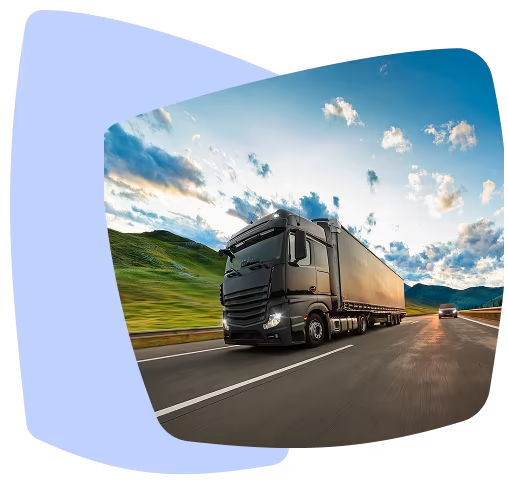
Our full-load road transport (FTL) service grew out of the need to offer Estonian exporters and importers a clear and managed solution for non-EU shipments. We approach FTL transport as a complete process in which, alongside the carriage and cargo insurance, customs formalities also play an important role. For us, logistics is not a stand-alone service but part of the customer’s supply chain.
Over the years we have built up our FTL road-transport capability, covering standard cargo, hazardous goods (ADR) and oversized cargo. The service covers customs clearance, including help with paying state duties and transit procedures, as well as cargo insurance. Our strength lies in our practical experience of full-load shipments to non-EU countries, where every route and shipment needs precise planning.
Today we serve manufacturing, industrial and trading companies as well as public-sector institutions that need a reliable, trustworthy partner for non-EU FTL road-transport solutions. Our role is not limited to ordering a truck — we help the customer make well-considered decisions across the entire transport chain and keep the process under control from start to finish.
We carry out Ro-Ro transport via the Port of Paldiski. For countries that do not have a direct connection with Estonia, we use Europe’s larger Ro-Ro hub ports as transit points to ensure a workable, time-predictable solution.
The Ro-Ro solution is intended for rolling stock, vehicles, trailers, heavy machinery and other cargo that is not suited to a container or whose dimensions and weight exceed the limits of standard containers. For non-rolling cargo we load the goods at the port onto MAFI trailers or cassette bolsters, allowing them to be moved onto the vessel.
The table below lists the main Ro-Ro routes and indicative transit times. The actual transit time depends on sailing schedules, the chosen line and any transit port used.
| Destination market | Main regions | Origin or destination | Cargo type | Estimated transit time* |
|---|---|---|---|---|
| Turkey | Istanbul, Ankara, Izmir, Bursa, Adana | All across Estonia | Standard cargo / hazardous (ADR) goods / special shipments | ~5–9 days |
| United Kingdom | London, Manchester, Birmingham, Liverpool, Leeds | All across Estonia | Standard cargo / hazardous (ADR) goods / special shipments | ~4–8 days |
| Norway | Oslo, Bergen, Trondheim, Stavanger, Kristiansand | All across Estonia | Standard cargo / hazardous (ADR) goods / special shipments | ~2–5 days |
| Switzerland | Zürich, Basel, Bern, Geneva | All across Estonia | Standard cargo / hazardous (ADR) goods / special shipments | ~3–6 days |
| Serbia | Belgrade, Novi Sad, Niš | All across Estonia | Standard cargo / hazardous (ADR) goods / special shipments | ~4–8 days |
* Full-load (FTL) transit times are estimates and depend on the route, border crossings, seasonality, weather conditions, shipping-line schedules, and customs and transit processes.
Our international road transport (FTL) is intended for industrial, manufacturing and trading companies as well as public-sector institutions that need non-EU road-transport services on a regular or project basis.
We carry out non-EU full-load (FTL) shipments, covering both imports into Estonia and exports from Estonia. We carry standard cargo, hazardous goods (ADR) and oversized full loads.
We help coordinate communication with overseas consignors and consignees. Operating as a customs agency, our service includes — on request — drawing up customs declarations, calculating and paying state duties, and opening and closing transit (T1) procedures.

Practical guidance for organising full-load (FTL) road transport for both imports and exports. We explain customs processes, documentation requirements and the calculation of state duties, and we cover the most common risks and practical questions related to non-EU shipments.

We carry out full-load (FTL) shipments between Estonia and non-EU countries, covering both imports into Estonia and exports from Estonia. With full-load transport, the entire trailer space is reserved for one customer’s cargo, and the shipment is planned based on the route, the nature of the cargo and customs requirements.
Below we answer the most frequently asked questions, from choosing the right trailer type and pricing through to documentation, customs declarations and transit procedures. If you don’t find an answer or your shipment is still being planned, get in touch — we are happy to give an initial assessment and practical input even when not all details are final.
FTL stands for Full Truck Load and means full-load transport in which the entire trailer space is dedicated to a single customer’s cargo. The same trailer is not used to carry goods for other customers during the same transport, and the shipment generally moves from the loading point to the destination without reloading the cargo in the trailer.
Full-load transport (FTL — Full Truck Load) means that the entire trailer space is dedicated to one customer’s cargo. The trailer does not carry goods for other customers during that order.
Part-load transport (LTL — Less than Truck Load) means that the goods of several customers are carried in one trailer, and shipments are pooled before transport. With part-load transport, the cargo may pass through terminals during transit and may be reloaded.
Full-load transport is a sensible choice when the volume or weight of the shipment fills a large part of the trailer, or when the whole trailer space is needed for just one customer’s cargo.
Based on our experience, it is worth considering full-load transport once the cargo takes up around 75% of the trailer space. A classic 13.6 m semi-trailer has a volume of about 90 m³, and 75% of that is roughly 67 m³ — or about 10 loading metres (LDM). At that scale, full-load transport may be more economical than part-load transport.
The customer doesn’t have to do these calculations — we assess each shipment individually and recommend the most sensible solution for the specific cargo.
The basis for non-EU full-load shipments is correct cargo and transport documentation. The commercial invoice and packing list — drawn up by the customer — are typically required. If the customer has no experience preparing these documents, we help with their preparation and review. An international CMR consignment note is also required, which we issue when needed.
For non-EU shipments (e.g. towards Ukraine, Norway, the United Kingdom) export or import declarations must be drawn up in Estonia and, depending on the route, also a transit document (e.g. T1). We arrange these formalities for the customer on request, as we also operate as a customs agency. In some cases other documents are required too, such as a certificate of origin, an A.TR document or other cargo-specific evidence needed for customs clearance.
For hazardous goods (ADR) a Material Safety Data Sheet (MSDS) is required and, where applicable, a Dangerous Goods Declaration (DGD) and other cargo-specific documents needed to handle and transport the hazardous cargo.
The data on the documents must match the actual cargo and transaction, since gaps or inaccuracies can cause delays at the border or in customs.
No, we do not offer full-load (FTL) transport to private individuals and we do not handle removals.
Our road-transport service is aimed at business-to-business (B2B) shipments. We arrange shipments where the consignor and consignee are legal entities and the movement is a commercial transaction requiring correct documentation and, where needed, customs clearance.
We do not perform loading or unloading at private addresses. For shipments and removals involving private individuals, we recommend contacting companies that specialise in international removals.
Yes, it does.
All carriers operating international full-load (FTL) shipments work under the CMR Convention; in Estonia the Law of Obligations Act (LOA) also applies. Under these rules the carrier’s liability is capped. The compensation limit is calculated on the basis of the cargo’s gross weight rather than its actual value. In practice this means that even for high-value cargo, the carrier’s maximum liability can be significantly lower than the cargo’s actual value.
For full-load transport the carrier’s liability is limited to 8.33 SDR per kilogram of gross weight. If, for example, the cargo is worth €10,000 and weighs 500 kg, the carrier’s maximum compensation will be around €5,000, depending on the SDR exchange rate. In other words, the regulatory compensation is lower than the cargo’s actual value. For such shipments, taking out cargo insurance is strongly recommended.
There are also cases where the carrier is not liable at all, regardless of the gross-weight-based cap under the CMR Convention — for example, when the damage is not directly linked to the carrier’s actions or falls outside the scope of liability under the conventions, such as fire, natural disaster or robbery. All-risk insurance can cover losses that fall outside the carrier’s liability.
For these reasons, taking out additional cargo insurance (all-risk insurance) is often a sensible move for non-EU full-load shipments. In our experience, more than 50% of customers opt for additional all-risk cover. We offer cargo insurance as an official reseller for insurer PZU. As we also act as an insurance reseller, we arrange the international shipment so that the customer obtains transport, customs service and all-risk insurance from a single company, without having to deal with several different parties or providers.
Practical articles on full-load (FTL) road transport and customs processes. We cover documentation, transit (T1), state duties, cargo insurance and the most common questions about non-EU shipments.
