
Ro-Ro transport is a sea-transport solution for oversized and heavy cargo that is loaded onto the vessel on wheels (roll-on / roll-off). The service is suitable for excavators, tractors, forklifts, loaders, trucks, trailers and other heavy machinery and project cargo. Where required, we make non-rolling cargo Ro-Ro–ready by loading it at the port onto a MAFI trailer or cassette bolster.
We arrange business-to-business (B2B) Ro-Ro transport on routes where the origin or destination country is Estonia. In Estonia, the Ro-Ro start or end point is the Port of Paldiski. Our main destinations are Asia (especially China–Estonia), the USA, Türkiye, the United Kingdom, Germany, the Netherlands and Belgium, as well as other European and non-EU markets. In addition to sea transport, we arrange pre- and on-carriage in line with the delivery term (Incoterms) and operate as a customs agency. The customer therefore has one responsible partner across the whole process, taking care of transport, customs and, if required, cargo insurance.
Our service covers the entire organisation of Ro-Ro transport — route planning, bookings, port handling, document checks and, where necessary, customs clearance. We arrange Ro-Ro transport for both self-propelled and non-rolling cargo, using MAFI trailers or cassette bolsters. We work with the world’s largest Ro-Ro shipping lines, providing strong global connectivity via the Port of Paldiski.
We are equally suited to regular Ro-Ro shipments and to project and special-cargo movements. We track the transport throughout the process and keep the customer informed of key deadlines, port handling and any potential changes.
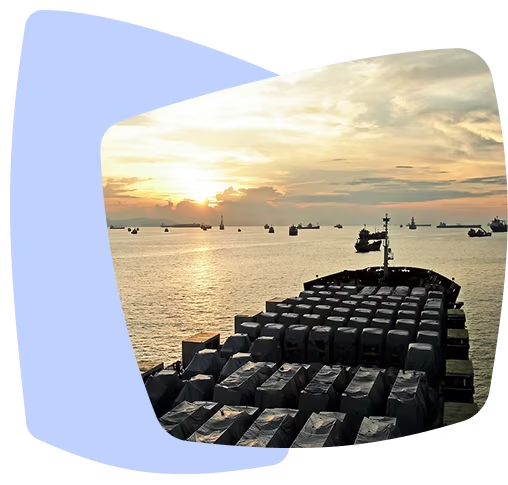
Our company started from a wish to offer Estonian businesses and the public sector a more flexible and reliable sea-transport service. We have built partnerships in which logistics is not simply a cost item but strategic support — from the procurement of equipment and machinery to the delivery of international projects.
Over the years we have grown from container and project shipments into a full-service sea-transport offering, of which Ro-Ro transport is an important part. Ro-Ro transport opens up the option of moving cargo that does not fit in a standard container and broadens our customers’ sea-transport choices. For each shipment we assess whether it makes more sense to use container transport with flat rack, open top or platform-type containers, or to choose Ro-Ro. Our strength is non-EU destinations, especially Asia and China–Estonia Ro-Ro shipments, and our practical experience managing international cargo flows and project shipments.
Today we serve industrial, construction, agricultural and trading companies as well as public-sector institutions that need a reliable partner for sea-transport arrangements. Our role is not just to arrange the shipment but to assess the suitability of solutions, mitigate risks and ensure professional handling of the entire transport process.
We carry out Ro-Ro transport via the Port of Paldiski. For countries that do not have a direct connection with Estonia, we use Europe’s larger Ro-Ro hub ports as transit points to ensure a workable, time-predictable solution.
The Ro-Ro solution is intended for rolling stock, vehicles, trailers, heavy machinery and other cargo that is not suited to a container or whose dimensions and weight exceed the limits of standard containers. For non-rolling cargo we load the goods at the port onto MAFI trailers or cassette bolsters, allowing them to be moved onto the vessel.
The table below lists the main Ro-Ro routes and indicative transit times. The actual transit time depends on sailing schedules, the chosen line and any transit port used.
| Destination market | Main origin and destination ports | Origin or destination port in Estonia | Suitable cargo | Estimated transit time |
|---|---|---|---|---|
| China | Shanghai | Paldiski | Tractors, excavators, trucks, agricultural machinery, equipment etc. Plus trailers, heavy machinery and other oversized cargo. Non-rolling cargo is loaded at the port onto MAFI trailers or cassette bolsters. | ~45–70 days |
| USA | Baltimore / Brunswick / Jacksonville / Newark-Elizabeth / Tacoma | Paldiski | Tractors, excavators, trucks, agricultural machinery, equipment etc. Plus trailers, heavy machinery and other oversized cargo. Non-rolling cargo is loaded at the port onto MAFI trailers or cassette bolsters. | ~25–45 days |
| United Kingdom | Tilbury / Harwich | Paldiski | Tractors, excavators, trucks, agricultural machinery, equipment etc. Plus trailers, heavy machinery and other oversized cargo. Non-rolling cargo is loaded at the port onto MAFI trailers or cassette bolsters. | ~4–8 days |
| Türkiye | Autoport (Istanbul) | Paldiski | Tractors, excavators, trucks, agricultural machinery, equipment etc. Plus trailers, heavy machinery and other oversized cargo. Non-rolling cargo is loaded at the port onto MAFI trailers or cassette bolsters. | ~10–20 days |
| Western Europe (Belgium, Germany, the Netherlands) | Antwerp / Zeebrugge / Bremerhaven / Cuxhaven / Lübeck | Paldiski | Tractors, excavators, trucks, agricultural machinery, equipment etc. Plus trailers, heavy machinery and other oversized cargo. Non-rolling cargo is loaded at the port onto MAFI trailers or cassette bolsters. | ~2–6 days |
Transit times are estimates calculated from the vessel's actual departure from the port of loading.
For non-self-propelled cargo, the time also depends on the availability of MAFI trailers or cassette bolsters at the port.
Our Ro-Ro transport is intended for industrial, construction, agricultural and trading companies as well as public-sector institutions that export or import self-propelled, self-rolling and non-rolling oversized or out-of-gauge machinery and equipment — including excavators, tractors, forklifts, loaders, trucks, trailers and other heavy machinery and project cargo.
We carry out Ro-Ro transport on routes where the origin or destination country is Estonia (Port of Paldiski) — both imports (e.g. from China to Estonia) and exports (e.g. to the USA). We arrange Ro-Ro shipments both on routes with a direct connection to the Port of Paldiski and on routes where there is no direct line — in which case the Ro-Ro shipment is routed through Europe’s larger Ro-Ro transit ports. We carry self-propelled, self-rolling and non-rolling out-of-gauge machinery and equipment, including excavators, tractors, forklifts, loaders, trucks, trailers and other heavy machinery and project cargo. Where required, we arrange pre- and on-carriage by specialist road trailer before or after the sea leg. For non-EU shipments, as a customs agency, we also draw up the necessary customs declarations.

Practical guidance for organising Ro-Ro transport. We explain the specifics of self-rolling and non-rolling cargo, describe the customs processes and offer advice on choosing the delivery term (Incoterms).

We carry out Ro-Ro shipments on routes where the origin or destination country is Estonia (Port of Paldiski) — both imports and exports. We arrange shipments both on direct routes and via transhipment through European Ro-Ro feeder ports on routes that lack a direct Ro-Ro connection with Estonia. The Ro-Ro solution is suited to self-propelled, self-rolling and non-rolling oversized and out-of-gauge equipment that is not practical to ship in a container.
Below we answer the most frequently asked questions — from suitability and route choice through to documentation, customs processes, port charges and applying the delivery term (Incoterms). If you don’t find an answer, get in touch — we’ll help you assess whether Ro-Ro transport is technically and economically the right solution for your shipment.
Ro-Ro transport (roll-on / roll-off) is a sea-transport mode in which cargo moves onto and off the vessel under its own power (self-propelled) — on wheels, tracks or belts via a ramp. The solution is suitable for self-propelled, self-rolling and non-rolling oversized and out-of-gauge equipment.
For cargo that neither self-propels nor rolls, the goods are lifted at the port by crane onto a MAFI trailer or cassette bolster, which allows them to be moved onto and off the vessel via the ramp. Ro-Ro is an alternative to container shipping when the cargo cannot be loaded into a standard or specialised container or when the Ro-Ro freight rate is more favourable.
Ro-Ro transport is the more suitable option when the cargo does not fit into a standard or specialised container (e.g. flat rack or open top), or when loading it into a container is not technically feasible due to dimensions, weight or shape. This applies mainly to oversized machines, heavy equipment, excavators, mobile cranes, tractors, forklifts, loaders, trucks, trailers and other project cargo and specialist equipment.
Ro-Ro can also be the right choice when the cargo is self-propelled or self-rolling and moving it via a ramp is simpler and more cost-efficient than loading it into a container.
For some cargo groups both Ro-Ro and container shipping are options. In that case it pays to compare which is more economical and to look at the expected transit times based on route, transhipments and shipping line. For every shipment we assess the cargo’s dimensions, weight, route and freight rate and recommend whether Ro-Ro transport or container shipping is more cost-efficient.
Container shipping is more suited to standardised cargo (e.g. on pallets, in boxes, in rolls or in packaged units) that can be loaded into a sea container and falls within the container’s size and load-bearing limits.
The vast majority of Estonia’s Ro-Ro cargo moves through the Port of Paldiski, where dedicated Ro-Ro vessels are handled. Most container shipments go through the Port of Muuga, a deep-water port equipped with container terminals. Ro-Ro vessels and container vessels are different types of ship by their nature — Ro-Ro vessels are built with ramps and lashing systems for rolling cargo, while container vessels are designed for stacking containers and crane handling.
As a rule, the customer delivers the cargo to the port’s waiting area and does not have to take part in the loading itself. Loading and discharging at the port of loading, transit ports and the port of discharge are performed by port and shipping-line staff, who handle the different types of machinery on a daily basis and have the relevant experience.
Self-rolling but not self-propelled equipment (e.g. semi-trailers) is hitched up to a specialist tug that pulls the cargo up the ramp onto the vessel and back down again. Cargo that neither moves nor rolls under its own power is lifted in the waiting area onto a cassette bolster or MAFI trailer, which is likewise driven onto the vessel by a specialist vehicle.
For certain rare items of equipment and specialist machinery we agree with the customer that their representative attends in person to load or unload the unit — for example, when the cargo is a remote-controlled, track-mounted drilling rig or another piece of equipment requiring specific handling skills.
No, we do not arrange Ro-Ro transport for passenger cars or minibuses, and we do not handle shipments for private individuals.
Our focus is business-to-business (B2B) and public-sector Ro-Ro transport for heavy equipment, oversized and out-of-gauge machinery, excavators, mobile cranes, tractors, forklifts, loaders, trucks, trailers and semi-trailers, road-maintenance and utility vehicles, military equipment, and other working machines and project cargo.
Yes, we regularly ship equipment and machines containing lithium-ion batteries from China, and volumes in this cargo group have grown markedly in recent years. Ro-Ro transport is suitable for such shipments, but it is always subject to prior coordination with the shipping line.
Imports from China increasingly include electric forklifts, loaders, mini-construction machinery, terminal-handling equipment, scissor lifts, battery-powered industrial equipment and energy storage solutions. Many of these are oversized and heavy units that are technically suited to Ro-Ro transport. Ro-Ro cargo from China typically reaches the Port of Paldiski via European transit ports.
Lithium-ion batteries generally fall under the IMDG hazardous-goods regulations. Shipping them requires correct documentation, including the MSDS and, where needed, UN 38.3 Test Summary information and the equipment’s technical data. Shipping lines have the right to impose additional conditions and to update their rules at short notice depending on safety requirements, risk assessments or internal line policy.
For every enquiry we check the route, the requirements of the specific Ro-Ro line and the equipment’s technical specifications. We have a physical agent on the ground in China who coordinates the shipment terms directly with the Ro-Ro shipping line. We then give the customer a clear confirmation of whether — and on what terms — the shipment can be carried.
Practical guidance for organising Ro-Ro transport. We cover the specifics of rolling and non-rolling cargo, explain the transport requirements and regulations for equipment containing lithium-ion batteries, describe the required documents (e.g. bill of lading) and offer advice on choosing the delivery term (Incoterms) on both EU and non-EU routes, including in the context of imports from China.
